
Wireless earbuds continue changing everyday listening experiences. Many users search for affordable alternatives delivering premium features without premium pricing. LibrePods gained attention because of their sleek design, stable connectivity, impressive sound quality, and simple usability. Understanding how LibrePods work helps buyers maximize performance while avoiding common setup mistakes.
This guide explains LibrePod’s technology, pairing process, charging system, controls, battery performance, and troubleshooting tips.
What Are LibrePods?
LibrePods are wireless Bluetooth earbuds designed for music streaming, phone calls, gaming, online meetings, and fitness activities. Unlike traditional wired earphones, LibrePods communicate with smartphones, tablets, laptops, and smart TVs through Bluetooth technology.
Each earbud contains:
- Bluetooth chip
- Rechargeable battery
- Built-in microphone
- Speaker driver
- Touch-sensitive controls
- Internal antenna
Together, these components create a cable-free listening experience.
Read More: What is LibrePods?
How Does LibrePods Work?
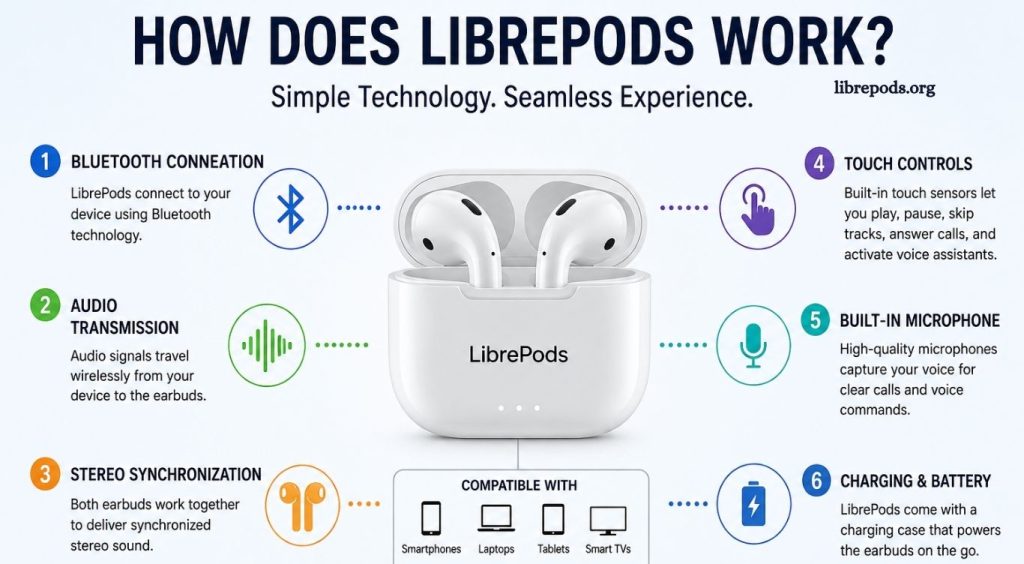
LibrePods use Bluetooth wireless technology for communication between earbuds and compatible devices. The process follows several simple steps.
Bluetooth Connection
After removing LibrePods from their charging case, both earbuds automatically power on. The primary earbud searches nearby Bluetooth-enabled devices. Once paired, both earbuds synchronize with each other while maintaining one stable connection with the smartphone or computer. This process usually requires only a few seconds.
Automatic Pairing
Modern LibrePods remember previously connected devices.
After initial setup:
- Open charging case
- Remove earbuds
- Bluetooth activates automatically
- Device reconnects instantly
Automatic pairing eliminates repeated manual setup.
Audio Transmission
Once connected, digital audio travels wirelessly from your device through Bluetooth signals. LibrePods decode those signals before converting digital information into clear sound through miniature speaker drivers inside each earbud.
Users enjoy:
- Music
- Podcasts
- Videos
- Phone calls
- Voice assistants
- Online meetings
without physical cables.
Stereo Synchronization
- Both earbuds communicate continuously.
- One earbud receives audio data before synchronizing playback with the second earbud.
This synchronization creates balanced stereo sound, delivering separate left and right audio channels for immersive listening.
How Charging Works
LibrePods include a portable charging case acting as both a storage container and a power bank.
Charging process:
- Place earbuds inside the charging case.
- Magnetic connectors align automatically.
- The internal battery begins charging immediately.
- LED indicators display charging status.
- Fully charged earbuds provide several hours of playback.
The charging case itself recharges using a USB cable or USB-C connection, depending on the model.
Touch Controls Explained
LibrePods replace physical buttons with touch-sensitive controls.
Common gestures include:
- Single tap: Play or pause music
- Double-tap: Skip track
- Triple tap: Previous track
- Long press: Volume adjustment or power control
- Hold touch: Activate voice assistant
- Tap during calls: Answer or end calls
Control options may vary by model.
Battery Performance
Battery life depends on:
- Listening volume
- Bluetooth version
- Active microphone usage
- Environmental conditions
- Codec efficiency
Many LibrePods models provide:
- 4–8 hours continuous playback
- Multiple additional charges using the charging case
- Fast charging capability
- Low-power standby mode
Proper charging habits extend battery lifespan.
Built-In Microphones
Many versions also include noise reduction technology, helping reduce surrounding sounds while improving voice clarity during:
- Video conferences
- Voice chats
- Phone conversations
- Voice commands
- Bluetooth Range
LibrePods typically maintain reliable connections within approximately 10 meters (33 feet) without major obstacles. Walls, metal objects, and crowded wireless environments may reduce effective range. Keeping paired devices nearby improves connection stability.
Device Compatibility
LibrePods work with most Bluetooth-enabled devices, including:
- Android smartphones
- iPhones
- Windows laptops
- Mac computers
- Tablets
- Smart TVs
- Gaming consoles supporting Bluetooth
No special software is usually necessary for basic functionality.
Common Connection Problems
Occasionally, users experience pairing issues.
Possible solutions include:
- Restart Bluetooth
- Disable Bluetooth, wait several seconds, enable Bluetooth again.
- Reset LibrePods
- Place earbuds inside the charging case, and follow the manufacturer’s reset instructions.
- Charge Completely
- A low battery sometimes prevents stable pairing.
- Remove Previous Pairing
- Delete LibrePods from Bluetooth settings before reconnecting.
- Update Device Software
- Operating system updates frequently improve Bluetooth compatibility.
Tips for Better Performance
Improve everyday listening with these recommendations:
- Keep firmware updated when available.
- Store earbuds inside the charging case.
- Avoid complete battery depletion regularly.
- Clean charging contacts carefully.
- Maintain Bluetooth range.
- Protect earbuds from water unless officially rated for water resistance.
Advantages of LibrePods
LibrePods offer several practical benefits:
- Wireless convenience
- Lightweight design
- Fast Bluetooth pairing
- Portable charging case
- Clear audio quality
- Hands-free calling
- Touch controls
- Wide device compatibility
- Long battery life
- Comfortable daily use
These features make LibrePods suitable for work, travel, exercise, and entertainment.
Conclusion
LibrePods deliver simple wireless audio through Bluetooth connectivity, intelligent pairing, touch controls, rechargeable batteries, and synchronized stereo playback. Easy setup, broad compatibility, and reliable performance make LibrePods an attractive choice for everyday listening, phone calls, remote work, fitness, and entertainment.